
Organizational Alignment
To unify our structure, I began by mapping the existing roles, responsibilities, and reporting lines across both Authenticom and Motive Retail. What immediately became clear was that while both teams were high-performing in their own right, they operated under different assumptions about success, authority, and ownership. This fragmentation was leading to duplicated efforts, conflicting customer engagement strategies, and internal competition — all of which needed to be resolved to unlock true collaboration.
I first initiated the organizational alignment phase by conducting a role audit through structured interviews with leadership and frontline team members. These conversations were critical not only in understanding day-to-day workflows but also in surfacing frustration points and areas of ambiguity. I then benchmarked these findings against industry norms and best practices for integrated sales and customer success teams.
From there, I created a proposed organizational structure that emphasized clarity, accountability, and advancement. I developed:
- Standardized Job Descriptions that emphasized core competencies and customer-facing objectives.
- Functional Titles that clearly indicated scope (e.g., “Strategic Account Manager” vs. “Vendor Account Manager”) and career track.
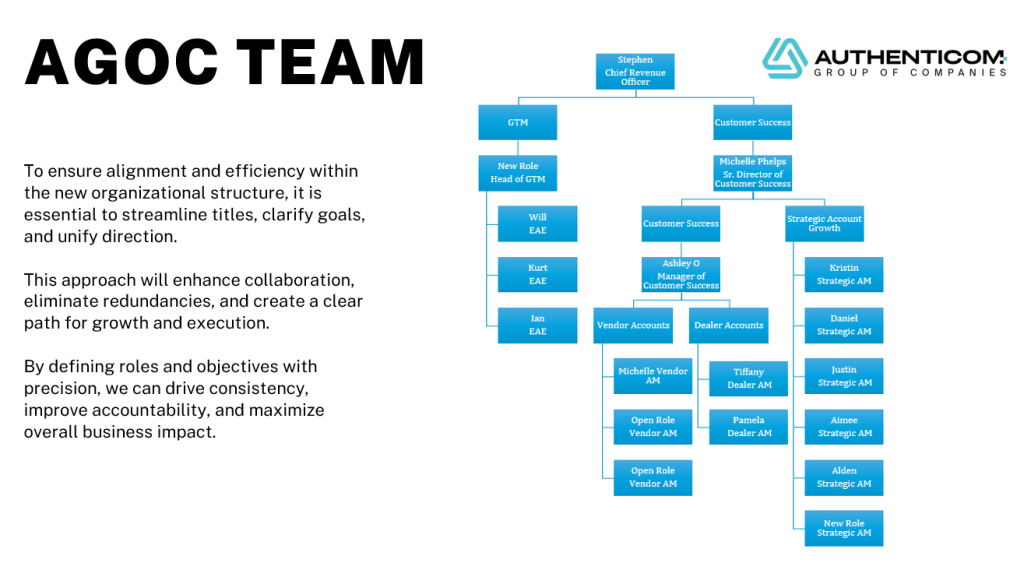
- Reporting Line Diagrams to visually communicate who reports to whom, and how cross-functional escalations should work.
This process required not just documentation, but a commitment to clarity. I facilitated working sessions with managers below and leadership above to ensure buy-in, and I hosted a series of Q&A sessions with affected team members to walk through the changes, invite feedback, and align expectations.
The below is the new unified structure and the newly redefined and created job descriptions for each of the roles that now report up to my role.
This phase taught me how deeply structure influences culture. People want to know where they fit and how their contributions matter. By clarifying roles and expectations, I didn’t just reduce confusion — I laid the groundwork for trust.
I also learned that transparency and dialogue matter more than perfection. Not every new title or description was universally applauded at first. But because the process was inclusive, and because I remained open to revision, the team was able to embrace the new structure as something they had helped shape — not something that was simply handed down.
Lastly, I learned that even “small” structural adjustments (e.g., changing a title from “Vendor Success Manager” to “Strategic Account Manager”) carry significant meaning for individuals and shape how they show up in customer interactions. Thoughtful naming and role clarity are not administrative chores; they are leadership levers one has to carefully weigh as titles mean a great deal to individuals and have a lasting impact on career progression.
 Lead to Inspire